
Issue 1: The Microplastics in You
The Strange Appetite for Plastics
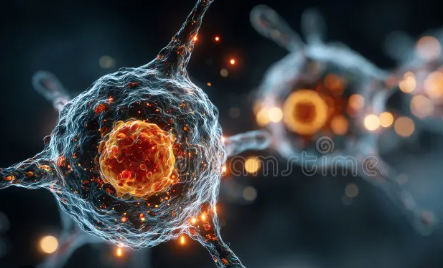
Macrophages are the immune system’s garbage collectors, engulfing invaders, chewing them down, keeping your inner terrain clean. But what happens when the “invaders” are tiny shards of our own making — microplastics that are smaller than bacteria, or nanoplastics that slip through cellular gates?
Animal studies show that macrophages do try to engulf these particles, treating them like pathogens. But here’s the twist: plastics aren’t biodegradable. Instead of digesting, macrophages choke on them, get stressed, and release inflammatory signals. That local irritation may ripple outward, priming the immune system into a chronic low-grade “buzz” of inflammation.
In other words: phagocytes are dutiful janitors given trash bags that never decompose. They keep trying, keep failing, and in the process exhaust themselves and agitate their neighbors. It’s a small but potent metaphor for our times, the body straining against synthetic debris it was never designed to process.
Why Wellth-e?
When people lose faith in the dollar, they look for other stores of value — gold, real estate, cryptocurrency. Everyone is trying to preserve what they believe matters, but few stop to ask what value actually means.
The oldest meaning of wealth has little to do with money. It comes from the Old English wela, meaning “well-being” or “prosperity,” derived from weal — the state of being well. Earlier still, in Proto-Indo-European roots, it was connected to wel- , “to wish, to will.” In other words, wealth once meant the fulfillment of what one most deeply wished for: health, safety, and wholeness.
That word health shares the same lineage. In Old English, hǣlþ meant “wholeness, a being sound or well,” from Proto-Germanic hailitho and Proto-Indo-European kailo- — “whole, uninjured, of good omen.” It’s related to hale (whole), heal, and even holy. To be healthy, in its earliest sense, was not just to avoid illness but to be whole and intact, a state so complete it was once synonymous with sacredness.
Somewhere along the way, these meanings split. Health became a medical term, wealth an economic one, and we began to treat the body as separate from value — the biological from the financial. We learned to measure worth in markets and forgot that the first market is physical.
Biology doesn’t deal in speculation. It runs on clear rules of exchange. Every bit of energy must be earned and accounted for. Sleep, nourishment, movement, and recovery are the deposits; inflammation, stress, and neglect are the withdrawals. The body’s accounting is exact, and its interest rates are high.
Yet we behave as if we have infinite credit, as though time, attention, and vitality are endlessly renewable. We can start healthy eating “tomorrow” or an exercise routine “after the holidays”. One more drink won’t hurt in the long run, and we do believe we have a very long run ahead. This is the same bias that drives financial bubbles: the illusion that exponential growth can continue forever.
In truth, the most stable economy is physiological. Energy is our base currency. Clarity, mobility, and vitality are its dividends. Health, not the dollar, is the standard against which all other assets should be measured.
So perhaps it’s time to return to the original sense of the word — wellthe: to be well-resourced in body, mind, and time. Because when the markets fluctuate and currencies fail, the only balance sheet that matters is the one written in your cells.
A wise mentor once told me: “Rich people just have money. Wealthy people have money and time.” And I’ve noticed that the wealthier people become, the more they spend their money buying time. From outsourcing work to buying young blood for infusions in the ultimate quest for more time (i.e. longevity), the wealthy recognize and understand real value.
Are you just rich, or are you wellth-e?

Get a preview of the upcoming weekly supplements and the Micromanage Your MicroPlastics Challenge for the month.
What to do about Plastics? To receive your ACTION SUPPLEMENTS to this issue, leave your email here:


Explore more from Issue #1: The Microplastics in You
Pick the next section to read in Issue #1
 Wellth-e