
Issue 1: The Microplastics in You
Right after I finished working on this issue, I heard an episode of a podcast I follow called My First Million. In that episode (6 under-the-radar trends), the host, Shaan Puri, talked about business trends that would explode in the next few years. One of them was “Plastic-free everything”. He and his co-host, Sam Parr, then went on to talk about the opportunities in the category. (**link below)
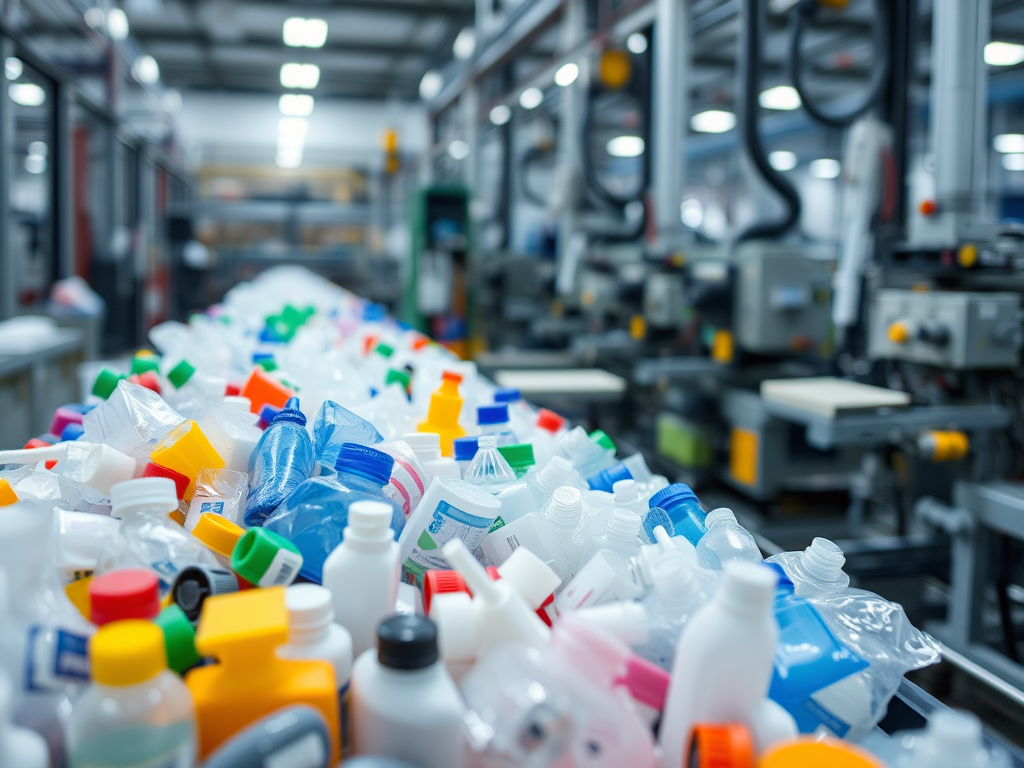
They’re on to something, because what reshapes our biology reshapes our markets. Microplastics aren’t only a health story, they’re an economic one. As regulators, consumers, and scientists sound alarms, pressure is mounting on industries that rely on plastic as a cheap default. That pressure creates both risk and opportunity.
- Risk: Companies heavily dependent on single-use plastics face regulatory crackdowns and consumer backlash. The EU has already banned certain items; more restrictions are likely in the U.S. and Asia.
- Opportunity: Firms developing alternative materials — biodegradable packaging, algae-based plastics, compostable films — are attracting new rounds of capital. The global biodegradable plastics market is projected to grow at double-digit rates over the next decade.
- Water & Filtration: Rising awareness of contamination is driving demand for advanced filtration technologies. Reverse osmosis, membrane innovations, and next-gen purification startups are becoming both household and institutional priorities. Investors are watching companies that can scale these solutions efficiently.
- Consumer Behavior: As with organic food two decades ago, there’s a willingness to pay more for products that signal safety. Early adopters often drive premium margins in this space.
Investment Signals to Watch
For those following the market side of this story, here are some themes worth tracking:
- Regulatory Timelines: Monitor upcoming legislation on plastics bans or extended producer responsibility (EPR). These often precede shifts in stock performance for packaging and consumer goods firms.
- R&D Pipelines: Companies with patents or partnerships in biodegradable polymers or enzyme-based recycling may be early winners.
- M&A Activity: Large multinationals often buy smaller innovators rather than reinventing themselves. Watch for acquisitions in packaging and filtration tech.
- Consumer Adoption Curves: Niche becomes mainstream quickly in health-conscious markets. The same dynamics that grew the organic food sector could apply here.
- Cross-Sector Plays: Don’t ignore adjacent industries — logistics (supply chains adapting to new packaging), healthcare (companies testing nanoplastics’ health impact), and insurance (pricing in environmental liability).
**Here’s the link to the episode (#688) on YouTube: https://youtu.be/sLaj1ta4wIA?si=iPxGZa8KRTVRXvjt
The part on plastics starts at 22:10 (And BTW, Shaan, if you’re reading–“Cotton? It’s absolutely a lie, yup!” Not really, not yet anyway, but stay tuned).
Spotlight: The Plastic Breakers — Biodegradable Polymers & Enzyme/Algae Recycling
What’s Emerging & Who’s Doing It
- Enzyme-based PET Recycling
- NREL (USA), University of Massachusetts Lowell, and University of Portsmouth have developed improved enzymes (PETases) that break down PET even from lower-quality, contaminated, or colored waste. Their process improvements (better reaction conditions, separation technologies) reduced energy use by ~65%, cut costs, and made recycling PET via enzymes more economically viable.
- Carbios (France) is a leader here. They patented engineered depolymerase enzymes that can degrade PET plastic bottles. In one project, they reported recycling ~90% of PET from bottles in ~10 hours under optimized conditions. Their industrial scale plant (France/Belgium) is scaling to ~130 tons/day capacity.
- Bioplastics from Algae / Spirulina / Macroalgae
- Researchers are using spirulina (a cyanobacteria / blue-green algae) to make biodegradable plastics whose mechanical properties resemble single-use petroleum plastics. Spirulina plastics are more carbon-neutral and may degrade more fully in composting environments.
- Macroalgae (seaweeds) are also promising: fast growth, high cellulose/sugar content → good feedstock for biopolymer or bioplastic production. Reviews show extraction + conversion is possible, though scaling and mechanical properties are limits.
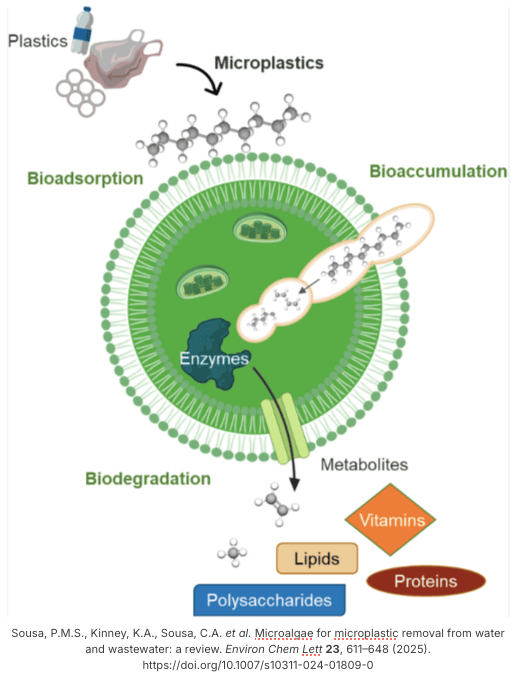
- Algae themselves in some studies have been observed to degrade certain types of plastic via enzymatic activity (micro-algae). For example, Algae for Plastic Biodegradation and Bioplastics Production reviews how microalgae synthesize enzymes/toxins that can degrade plastics in lab settings.
- Companies & Biodegradable Additive Alternatives
- Polymateria (UK) developed a Biotransformation additive/masterbatch that helps polyolefins (PE, PP) biodegrade in real environments (<1 year under ideal exposure) into wax-like intermediates that bacteria/fungi can finish off. They claim no microplastics left behind.
- BioSphere Plastic produces biodegradable additives for synthetic polymers; they aim to enhance biodegradation via their additives.
What Questions Remain: Are We Truly Breaking Polymers Into Inert Compounds?
- Some innovations (like Algenesis’s algae-based polyurethane) report that materials break down over months in compost, and claim minimal microplastic fragments remaining after environmental biodegradation. But often “break down” means into smaller fragments first (which might count as microplastics) until microbes or enzymes further degrade them.
- Enzymes like PETases break PET into monomers (terephthalic acid and ethylene glycol), which can then be metabolized by microbes or repurposed. This suggests true polymer breakdown vs. mere fragmentation. Carbios’s PET depolymerase is designed to get to those monomers.
- Algae-derived bioplastics often still need specific composting conditions (temperature, moisture, microbial community) to fully degrade. If they end up in unmanaged environments (landfills, oceans), they may degrade slowly or fragment first. Macroalgae bioplastics sometimes have mechanical weaknesses (heat sensitivity, water absorption) that limit utility.
Bottom Line: What It Means for Early Winner Potential
- Companies making true enzyme depolymerization (like Carbios, NREL’s collaborators) are likely early winners — they can convert polymer → monomer → reuse, potentially closing the loop.
- Bioplastics from algae and macroalgae are promising as renewable feedstocks, especially for single-use or short-lifetime applications (packaging, bags, wraps) if their properties and scale can be improved.
- Additive-based technologies (like Polymateria) that cause conventional plastics to break down environmentally may help reduce litter and microplastic formation, though performance depends heavily on exposure conditions.
Prosper Takeaways
- Invest or watch: Enzyme-recycling firms (Carbios, NREL, others) and algae-bioplastic startups.
- Caveats: Check for end-point of degradation (do they report monomer/CO₂, not just breakdown)? Check environmental conditions needed.
- For policy / scale: Incentives/standards will matter — requiring not just “biodegradable” but “demonstrably no microplastic residue” under realistic conditions.
The lesson? Plastics are becoming an investment signal. Where they accumulate in the body, they also accumulate risk in balance sheets. The flipside is equally true: firms that engineer resilience — through materials science, filtration, or regulatory foresight — stand to prosper.
Reader Action:Keep an eye on companies innovating in biodegradable packaging, water filtration, and sustainable materials — they may be tomorrow’s health-and-wealth growth stories.
Prosper Signals
Key markers to watch:
- Regulation → Track upcoming bans or EPR laws on plastics.
- Innovation → Companies advancing biodegradable polymers or enzyme recycling.
- Filtration Tech → Growth in reverse osmosis and advanced water purification.
- M&A Moves → Multinationals acquiring niche packaging/filtration startups.
- Adoption Curves → Shifts from niche → mainstream in sustainable products.
References
- National Renewable Energy Laboratory (NREL). (2024). Enhanced PETase enzymes for low-energy plastic depolymerization. [NREL Research Highlight]. https://www.nrel.gov/news/program/2024/enzyme-based-plastic-recycling.html
- University of Massachusetts Lowell & University of Portsmouth. (2024). Collaborative breakthroughs in enzyme-driven PET recycling. [Joint press release]. https://www.port.ac.uk/news-events-and-blogs/news/plastic-eating-enzyme-breakthrough
- Carbios S.A. (2023). Industrial-scale enzymatic recycling of PET plastics: Process overview and performance results. Carbios Corporate Report. https://www.carbios.com/en/
- Wikipedia. (2025). Carbios. [Updated entry]. https://en.wikipedia.org/wiki/Carbios
- World Economic Forum. (2024). How algae could help end plastic pollution. [Innovation Feature]. https://www.weforum.org/agenda/2024/03/algae-plastics-biodegradable/
- Sajid, Z., & Park, S. Y. (2023). Bioplastics from spirulina and microalgae: Sustainable synthesis and performance review. Marine Biotechnology, 25(4), 677–690. https://doi.org/10.1007/s10126-023-10246-9
- Tanna, B., & Mishra, A. (2024). Macroalgae-derived biopolymers: Extraction, properties, and environmental fate. Polymers, 16(8), 1524. https://www.mdpi.com/2073-4360/16/8/1524
- Maharana, A., Pramanik, S., & Ghosh, T. (2023). Algae for plastic biodegradation and bioplastics production: A review. Frontiers in Microbiology, 14, 1134235. https://pmc.ncbi.nlm.nih.gov/articles/PMC1134235/
- Polymateria Ltd. (2023). Biotransformation technology: Real-world biodegradation of polyolefins. [Corporate White Paper]. https://www.polymateria.com/science
- BioSphere Plastic. (2024). Biodegradable additives for conventional polymers: Product overview. [Corporate Report]. https://www.biosphereplastic.com/
- ABC News. (2024). Can algae really eat plastic? Inside the race for biodegradable alternatives. [Environmental Feature]. https://abcnews.go.com/Technology/algae-biodegrade-plastics
- Algenesis Materials. (2024). Algae-based polyurethane and biodegradable polymers: Performance and degradation testing. [Company Technical Report]. https://www.algenesismaterials.com/
- MDPI Review Collective. (2025). Scaling bioplastics from algae: Challenges in mechanical stability and composting. Sustainability, 17(3), 1553. https://www.mdpi.com/2071-1050/17/3/1553
Want a whimsical take on how your immune system reacts to microplastics? Read my Phagocyte Section to find out.
What to do about Plastics? To receive your ACTION SUPPLEMENTS to this issue, leave your email here:


Explore more from Issue #1: The Microplastics in You
Pick the next section to read in Issue 1
 Wellth-e